
Apply to join the SustainUS delegation to the UN Commission on the Status of Women!


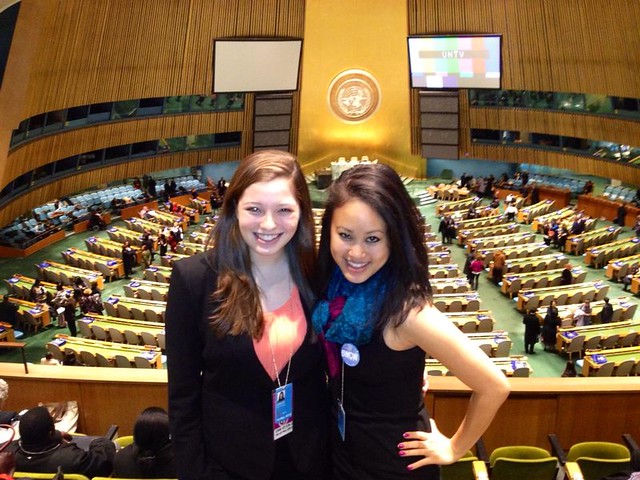
Delegates Sarah Handler and Elizabeth Tang at the opening ceremony of the 57th Commission on the Status of Women.

SustainUS is now accepting applications to join the Agents of Change (AoC) youth delegation to the 58th Commission on the Status of Women (CSW-58), which will be held at the United Nations Headquarters in New York City from March 10-21, 2014. CSW-58 will address the theme: “Challenges and achievements in the implementation of the Millennium Development Goals for women and girls.”

Selected delegates will have the opportunity to work with government officials, scientists, civil society representatives, and youth from around the world to review progress on issues related to gender equality and advancement of women. In the past, AoC delegates have presented case studies and policy statements on behalf of youth; participated in forums with fellow representatives of civil society; and met with government delegates, international organizations, and the US State Department.

Delegates are expected to contribute something unique to our efforts to take part in the international policymaking process and increase youth participation in the global arena. The delegation will especially benefit from delegates with grassroots and policy experience in gender equality, advancement of women, and youth issues. Young people with academic interests in the topics and organizing experience are also encouraged to apply. SustainUS is committed to selecting a skilled, diverse, and passionate delegation. CSW is a great way to become familiar with the UN, and we welcome newcomers!

AoC delegates will be expected to engage in substantial preparation in the months leading up to the Commission, which may include working with media outlets, giving community presentations, and personal fundraising. Delegates will be required to stay in regular email contact and take part in research and conference calls. The days during CSW-58 will be long yet fulfilling, as delegates will contribute to the delegationʼs goals as a team while taking initiative in their areas of interest.

The delegation will be assisted by delegation leaders Emilie Litsas and Sarah Handler, who are CSW veterans, and the Agents of Change program coordinators, Yi Wang and Alyssa Tsuchiya. The delegation leaders will organize sessions and support delegates in navigating and contributing meaningfully at CSW-58. SustainUS will also arrange for accreditation and assist delegates in finding housing in New York City.

Application Procedure

Access the application form with the button above, or hereApplications must be received by 5:00 pm EST on Sunday, January 19, 2014. Incomplete applications will not be considered.

All applicants will be notified of the application results by late January, and the selected candidates will be required to confirm their participation shortly thereafter. If you have any questions, please contact AoC Coordinators Yi Wang and Alyssa Tsuchiya at agents@sustainus.org.

Online Q&A Session

SustainUS will hold one live application troubleshooting session for interested applicants on January 12, 2014 at 8 pm EST.

Instructions for joining the webinar:

1. Go to: https://global.gotomeeting.com/join/650103629 and use your microphone and speakers (VoIP) – a headset is recommended. Or,

2. Call in using your telephone.
Dial +1 (773) 897-3000
Access Code: 650-103-629
Meeting ID: 650-103-629

Look forward to meeting you there!

Frequently Asked Questions

What is SustainUS?

Founded in 2001, SustainUS is a nonpartisan, youth-run, volunteer-led organization advancing sustainable development and youth empowerment. Through proactive education, research, and advocacy at the policy-making and grassroots levels, we are building a future in which all people recognize the inherent equality and interdependence of social, economic, and environmental sustainability. We strive to reflect our values through the diversity of members and projects, our ongoing commitment to educating ourselves and others, and the way we live our lives.

What is Agents of Change?

Agents of Change is SustainUS’ largest national program. Agents of Change offers young people from all over the country to opportunity to take part in high-level meetings at the United Nations that directly affect the world that we as young people will inherit.

What is CSW?

The United Nations Commission on the Status of Women is dedicated to promoting gender equality by identifying challenges and establishing standards for the social, economic, political, and civil rights of women. Member states and non-government representatives, including the SustainUS delegation, will share and evaluate experiences, lessons, and best practices, as well as identify key goals for further advancement of women. Meetings take place once per year, usually in March.

SustainUS has organized youth delegations to CSW since 2009, the 54th Session.

Who can apply?

  • Applicants are required to be between 13 and 26 as of March 2014. Youth under the age of 18 must be accompanied by a parent or guardian to CSW.
  • Applicants must be either (a) be a US citizen or (b) have studied or worked in the US for more than six months.
  • Applicants need not have previous experience with SustainUS or gender policy. We welcome newcomers!
  • Unfortunately, participation in the program requires accreditation from the United Nations, so we are unable to accept applications from undocumented youth.

When is the program?

CSW-58 takes place March 10–21, 2014. We expect selected delegates to attend the entirety of the conference, to the best of their ability.

Delegates are also expected to dedicate 1-5 hours of work per week preparing for CSW from late January until the conference.

Where is the program?

CSW-58 takes place in New York City at the United Nations Headquarters.

The preparation work for CSW will be done remotely via email and conference calls.

When is the application deadline?

Sunday, January 19, 2014. Please email agents@sustainus.org with any questions, or to request a deadline extension.

What are the participation costs?

Participation in the Agents of Change program and CSW-58 is free! However, delegates must fund their own housing, food, and travel costs. Financial standing should not be a barrier to application or participation. The delegation leaders and Agents of Change Coordinators will support delegation members in fundraising, and scholarships are available for delegates from underrepresented background. Please email agents@sustainus.orgfor details.

Japan Fund for Global Environment: Grants for NGOs

Deadline: 12 February 2014
Open to: non-governmental organizations or a non-profit organizations working in the area of environmental conservation
Grant: Average grant per project is 4 million yen

Description

The Environmental Restoration and Conservation Agency of Japan (ERCA) has established the Japan Fund for Global Environment (JFGE) through an initial endowment from the Japanese government together with contributions from the private sector, including individuals and private corporations. The interest accrued from these funds is then used to provide support to NGOs working in the area of environmental conservation.

The Japan Fund for Global Environment has been supporting various environmental conservation projects in and outside Japan from the time of its establishment in 1993. With a broader objective to develop national movements to protect the global environment, JFGE aims to support the NGO projects for environmental conservation in developing regions with immediate needs; strengthen Japan’s involvement in global environmental conservation; and to offer people from different fields and classes a chance as a Global Citizen, to participate actively in environmental NGO projects or to contribute money to support environmental NGO projects.

Eligibility

The JFGE supports non-government organizations that work hard and steady for environmental cooperation at a grassroots level from the viewpoint of global environmental conservation. Eligible organizations will be juridical persons or other organizations that are non-profit and base their activities on the public will. This qualification includes foundations, incorporated association, specified non-profit organizations. Unincorporated associations are also included. Business enterprises and local public bodies are not eligible.

Because this grant program is financed with government and private contributions and the grants are awarded through an official system, it is necessary to ensure that grants’ money are used in accordance with the stated goals and that the projects awarded grants are actually implemented.

To give this assurance, grant recipient organizations must be non-government organizations that are engaged in global environmental conservation activities and that are one of the following:

1. Juridical persons in Japan established in accordance with the provisions of Article 34 of Japan’s Civil Code, or their equivalent nonprofit organizations.

2. Organizations in Japan founded in accordance with the provisions of Article 10 of Japan’s Law to Promote Specified Nonprofit Activities and engaged in specified nonprofit activities.

3. Non-governmental, nonprofit, unincorporated associations that satisfy all the requirements below:

  • The association must possess Articles of Incorporation or equivalent bylaws.
  • The association must possess a well-established body that makes decisions for the organization and implements the project for which the Grant is requested.
  • The association must possess an accounting structure capable of bookkeeping and self-auditing.
  • The association must possess an office that serves as a base of their activities.
  • The association must be deemed to have capacity to execute the project for which the Grant is sought, judging from its track record.

Grants

Two types of grant are available for this year. If your organization was established less than ten years ago and it is the first time to be granted by JFGE, you must download the Entry grant  guide. Otherwise download the Regular Grant guide.

Application

The deadline for applying is 12 February 2014.

Download the Grant Application Form for new projects HERE ( Grant Application Form (New Projects) (PDF 460KB) ) or for continuing projects HERE ( Grant Application Form (Continued Projects) (PDF 442KB) ). The following procedures should be fulfilled:

  1. Organizations wishing to apply for the JFGE Grant must submit the Grant Application Form during the fixed time period for that fiscal year (beginning of January to middle of February) to the Environmental Restoration and Conservation Agency (see contact details below).
  2. The Environmental Restoration and Conservation Agency shall conduct a review and hearing on the contents of the grant applications. An informal decision on grant recipients and grant amounts will be made based on the opinion of the JFGE Management Council. The selected organization will be sent a notification of informal approval for JFGE Grant.
  3. If the selected organization decides to accept the contents of the informal approval, the organization must prepare the Letter of Consent for JFGE Grant based on the informally approved amount and send it to the Environmental Restoration and Conservation Agency within a month.
  4. The Environmental Restoration and Conservation Agency, upon receipt of the Letter, will examine the contents of the Letter and then send a Notification of JFGE Grant Approval to the approved organization.

Environmental Restoration and Conservation Agency Department of The Japan Fund for Global Environment address:

Muza Kawasaki Central Tower, 8th floor 1310, Omiya-cho, Saiwaiku, Kawasaki City, Kanagawa Prefecture 212-8554, Japan
Fax 81-44-520-2190
E-mail jfge@erca.go.jp

For further information, please visit the official website.

The Summer School on Global Studies and Critical Theory, Bologna

Deadline: 16 April 2014
Open to: postgraduate and graduate students
Venue: June 23rd – July 4th 2014 in Bologna, Italy

Description

  • The School on Global Studies and Critical Theory is a new summer program jointly promoted by Duke University and the Department of History, Cultures and Civilization of the University of Bologna in the conviction that the so-called global age makes necessary a radical rethinking of our theoretical tools and critical exchange among different research fields. Each year in a lively and stimulating intellectual and cultural environment outstanding scholars will offer to faculty, postgraduate and graduate students, lectures, intensive courses and seminars on one specific topic of this contemporary global turn, encouraging the collective production of knowledge and critical thought.

Eligibility

The call is open for postgraduate and graduate students

Costs

200€ (Including Welcome and Closing Cocktails)

400€ (Including also Accommodation at the Hotel Touring, in the heart of Bologna’s Centro Storico, 8 minutes walking from the Department of History, Culture and Civilization, where classes will take place.)

Payment is available via Bank Transfer to University of Bologna’s Department of History, Culture and Civilization. 

Bank Transfer Details:

  • to: Dipartimento di Storia, Culture, Civiltà dell’Università di Bologna
  • bank: Unicredit S.p.a.
  • IBAN number: IT68V0200802457000102271585

Selected Students are required to confirm their inscription by paying the fees before May 30th and sending a copy of their receipt to greta.messori@gmail.com.

Check out for Grants opportunities.

Application

Applicant Students should send the following materials:

  • A Detailed Curriculum Vitae
  • A Statement of Purpose
  • A Letter of Recommendation

Applications and Documents must be sent by e-mail to raffaele.laudani@unibo.it before april 16th 2014.

Students accepted in the program will be notified by April 30, 2014 on this website.

Registration Fees are due by May 30, 2014. Please send receipts to greta.messori@gmail.com.

For further information, please visit the official website.


World Merit – Merit Next !

Deadline: No Deadline

Open to: Young leaders and social entrepreneurs from the worldwide

Remuneration: scholarship of the value of 15,000 $


Description

A 12 Month Accelerator Program taking you to Liverpool, London, New York and Washington D.C

Want to be one of the 120 talented people from across the world selected for the fully sponsored yearlong leadership program? Merit Next has been designed to reward people who are passionate about making a positive impact on the world through providing a unique program that takes you to 4 cities and provides 11 months of online mentoring and global collaboration.

In July 2014, the Merit Next Fellows will convene in London & Liverpool for two weeks of inspiration, aspiration assessment, and team building. For the next 11 months, the fellows will engage in online training and education, and one-on-one mentoring designed to support personal and professional life plans. Through this, you will build the capacity to run global projects while building a global network of trusted advisors. In June 2015, the group will reconvene in the New York & Washington to present their final reports to a panel of entrepreneurs, executives and venture capitalists. You will accelerate your public speaking, project management and team leadership capacities whilst also collaborating on a Global Challenge that will work to tackle real world problems.

Eligibility

Our application process is NOT based on your educational background or your financial circumstances. We reward people based on their merit!

Remuneration

120 scholarships of the value of 15,000 $ bringing you to UK and US

Application

  •  Register online and create a profile at www.worldmerit.org (ID: 67288)
  •  Connect with people in our community of over 60,000 people from around the world
  •  Take part in our challenges to earn over 10,000 merit credits
  •  Be a role model to people from our community across the world

Do you have what it takes? Find out more at www.worldmerit.org

Documentary fund seeks projects [Worldwide]

Producers and filmmakers from developing countries can apply.

The IDFA Bertha Fund is looking for new creative documentary projects from developing countries. The fund supports documentary filmmakers (and festivals) with financial contributions to complete their projects.

The four categories are project development, production, post-production and documentary festivals (to be confirmed in February). Argentina, Brazil, Chile and Mexico are eligible only for the project development category.

Upon selection, the fund works with the filmmakers to determine which form of assistance and coaching would be most suitable to their project. The support is intended to enhance the script, production, editing or access to the international market.

Grants are in the range of EUR5,000 (US$6,795) – EUR17,500 (US$23,785), depending on the category.

The deadline is Feb. 1.

For more information, click here.

Youth Journalism International Contest

Student reporters, cartoonists and photographers ages 19 and under can enter a contest.

Youth Journalism International hosts a contest recognizing exceptional journalism done by students worldwide.

The top five honors include Journalist of the Year, Educator of the Year, the Courage in Journalism Award, the Jacinta Maria Bunnell Award for Commentary and the Frank Keegan “Take No Prisoners” Award for News.

Other categories include multimedia, news, enterprise, profile, features, editorial, column writing, first-person essay, cartoons, reviews, sports and photography.

Entries must have been published between Jan. 1 and Dec. 31, 2013 in online or print publications. School publications, underground papers, blogs, online papers and other venues for journalism are all acceptable.

The entry fee is US$20 for the top honors, US$10 for team entries and US$5 for individuals. The deadline is Feb. 7.

For more information, click here.

International Youth Forum, Turkey

International Youth Forum on inter-cultural dialogue and confidence building measures across the Black Sea Region:

Turkey, Istanbul, Holiday INN Hotel

February 19-22, 2014


Young people growing up in regions affected by armed conflicts, being exposed to and/or enduring the consequences of extreme forms of physical and structural violence, are often confronted with dramatic life forming experiences, emotions and challenges. Such experiences may strongly influence their views and behaviour towards their own and other communities, their relation to conflict and peace and to their identity. Many young people, despite often adverse circumstances, choose to engage in constructive initiatives and dialogue instead of becoming themselves the multipliers of hatred and rejection which fuel prejudice. When supported and recognized in their role, these young people may become peer leaders and educators and, in turn, sensitize and involve other young people in dialogue, mediation, intercultural communication, conflict transformation and peace work projects.


This project aims at changing the currently fluctuating attitude of young people regarding the possibilities of resolution of the conflict, which include today a variety of non-peaceful options, towards a peaceful and compromising standpoint in which youth will strive only for a peaceful resolution of the conflict through confidence-building.

The aim of the project is to engage young people and youth organizations from conflict stricken regions in dialogue and conflict transformation activities based on human rights education and intercultural learning and to provide them with a positive experience in living and learning together.


The main goals of the project are as follows:


–      To provide participants with information and knowledge on the European experience of building cooperation and understanding between participating country nations

–      To have discussion on the positive and negative aspects of the policies carried out in Black Sea and Caucasus in peace building, achieving economic prosperity and strengthening the national identities of the Caucasian people during  last 15 years

–      To discuss the probable models of the peace building policy in the region of Black Sea and South Caucasus  highlighting and applying “European experience”

–      To have a discussion on  “Common House of the Black Sea and Caucasus” cooperation and integration  model

–      To identify the role of Youth NGO’s for the future regional cooperation in the region


Target group(s):


Young leaders, youth workers, young women, students, civil society activists, NGO representatives and local community members from Azerbaijan, Armenia, Russia, Ukraine, Moldova, Turkey, Georgia, Greece, Albania, Romania, Bulgaria and Serbia.


The main activity of the project is contributing to the confidence-building process in one of the most fragile regions in the world, namely in Black Sea and Caucasus. We believe that in order to achieve this target, firstly we should form a regional forum of youth group where problems of regional cooperation could be discussed. Thus, in short term this a unique opportunity for us to discuss with our partners from various countries.

The project will use the methods like the plenary sessions, workshops, discussions, working groups. The organizers would like to stress the need of creating informal bounds between participants, especially by: meetings in different conditions, “round-table” meetings, simulations, different educational modules, evaluation meetings, social program and case studies devoted to the specific issues of civil society and NGO co-operation in multi-cultural environment.


The international meeting is direct contact of all the partners, as well as creating an exact timing of all activities.

So far we have chosen the issues (I-VIII), around which we intend to create the Partnership:

I – crisis management, solving international conflicts (e.g. Russian – Georgian, Moldavian – Russian, or Ukrainian)

II – cultural diversity and inter-cultural dialogue

III – human rights

IV – democracy development in Black and Caucasus countries

V – Civil society, social activity

VI – historical, cultural, religious heritage

VII – sustainable development

VIII – other issues, invented during the co-operation


Program elements:


  1. To develop the conceptual and practical meanings of conflict, peace, and conflict transformation.
  2. To share among participants their personal experiences of conflict and violence and their coping strategies, identifying commonalities and specificities between them
  3. To develop the competences of participants in conflict transformation and intercultural learning, including a critical understanding of the personal and collective identities and their role in armed conflicts
  4. To learn about human rights and human rights education as frameworks for conflict transformation and dialogue
  5. To learn from existing practices and experiences of people within the youth field working on dialogue and conflict transformation


Participant(s):


From each country will participate 2 delegates. The participants applying the Forum should have experience of working on the area of conflict management, peace education, youth cooperation and confidence building measures. During the plenary sessions every country delegates should make an introduction of their country case. Every participant should be prepared in advance for presentation of the country case and in the introduction should give information about the programs being implemented in every country and confidence building measures.

During the Forum will be discussed the following topics:

  • stimulate democratic and economic reforms
  • support stability and promote development
  • facilitate practical projects in areas of common concern
  • open up opportunities and challenges through coordinated action in a regional framework
  • encourage the peaceful  resolution of conflicts in the region

Our vision, as the young leaders is that, historically, the Black Sea region has been rather a cooperation medium than a barrier. Naturally it has allowed for communication and exchange (either cultural or economic). Youth organizations in the region are very similar, in terms of origin, path and challenges they are facing. There are numerous lessons learnt and expertise which are worth sharing. Youth organizations have the vocation to act jointly to bring positive social change for both their countries and for the region as a whole.

There are following main defining elements of this Forum, within the Black Sea cooperation framework:

  • The focus of the Youth Forum is on young leaders and youth organizations as a particular transformative force throughout the region, bearers of democratic values and advocates of open societies, human and social rights, peace and solidarity throughout the region.
  • The Youth Forum aims to bring together young leaders and youth NGOs from all the countries in the wider Black Sea region as a forum for specialized regional dialogue and cooperation and with young leaders and youth organizations and institutions active in the region.
  • The Forum brings around the same table a broader constituency: civil society, EU and international donors and officials from the region or involved in the region, thus supporting capacity building for these actors in order to overcome current gaps in access to information and funds, as well as in implementation practices.


Travel reimbursement and accommodation:


After presenting air tickets, invoices and boarding passes to the organizer of the Forum, the participants will get their reimbursement. In the case of request, organizer of the Forum may purchase the air tickets of the participants in advance. Participants will be provided with accommodation and lodging.

Arrival days of the participants is on 19 of February 2014 and departure day is on 22 of February. The dates of the Forum are 2 days-20-21 of February 2014.

The Forum will be organized in Holiday INN Hotel. Address: Turgut Ozal Cad No 189 Topkapi , Istanbul,Turkey.  

Participants are responsible for arriving to the hotel from the Ataturk airport in Istanbul by using direct metro or bus.

The website address of the hotel: http://www.hiistanbulcity.com.tr/


Applications form is HERE

Festival of adventure films open

Professional and amateur filmmakers with works on mountaineering and all kinds of extreme adventures from all over the world can compete in this contest.

The International Festival of Mountaineering and Adventure Films “Vertical,” a member of the International Alliance for Mountain Film, will take place May 27 – 30, 2014 in Moscow.

Documentaries, animation and feature films, created in 2010 – 2014 are accepted. International competition includes these documentary categories: mountain climbing, travel and adventure, and nature and ethnography. Russian competition includes two categories – TV programs and amateur films.

Submissions in languages other than English and Russian should include a translation in English.

The entrance fee is RUB500 – RUB700 (US$15 – US$21), depending on the category.

The deadline is March 28.

For more information, click here.

ANIMAFEST Zagreb 2014: Animated Film Competition

Deadline: 1 February 2014
Open to:  filmmakers applying all animation techniques
Prize: cash awards of up to 2,500 €

Description

The 24th World Festival of Animated Film – Animafest Zagreb is an international competition festival of short animated films that will be held in Zagreb from 3 to 8 June 2014.

The World Festival of Animated Film in Zagreb is traditionally the second oldest festival in Europe. In the course of its forty-year-old history it has systematically been following world animation production through a number of films in competition and out of competition. Built on the tradition of the Zagreb School of Animation, Animafest, the festival oriented towards auteur film, has made a reputation of being one of the most significant events in the domain of animated film.

Films can be submitted for one of the following competition categories: Grand Competition, Student Competition, Films for Children Competition, Commissioned Film Competition. NOTE: Films suitable for children that are submitted for Grand or Student Competition category can also be submitted for the Films for Children Competition category.

Eligibility

Animafest’s submissions are open to films applying all animation techniques, including combinations of live action and animation. Over 50% of the production must consist of animated sequences. Films must be completed after 1 January 2012 and with maximum running time of 30 minutes. Films previously entered at Animafest will not be taken into consideration.

Awards

Grand Competition

  • Grand Prix (best short film of the festival) – cash award of 2,500 € 
  • Golden Zagreb Prize (encouragement of creativity and innovative artistic achievement) – cash award of 2,000 € 
  • “Zlatko Grgić” Prize (best first production apart from educational institutions) – cash award of 1,500 €

Student Film Competition

  • “Dušan Vukotić” Prize (best student film) – cash award of 1,000 €

Films for Children Competition

  • Best film for children

Commissioned Films Competition

  • Best Commissioned Film

“Mr. M” Award – audience award
Best Animation School – award to an educational institution for the best choice of films submitted for selection (at the discretion of the Student Competition Selection Committee)

Application

There is no entry fee required. Online entry forms and instructions how to submit you entry are available HERESubmission deadline is 1 February 2014.

NASA Space Settlement Contest for High School Students

Deadline: 1 March 2014
Open to: students up to 12th grade (18 years old) from anywhere in the world
Award: $5,000

Description

The annual NASA Space Settlement Contest has opened for entries for 2014. This annual contest, co-sponsored by NASA Ames and the National Space Society (NSS) is for students up to 12th grade. The NASA Space Settlement Contest has been created to research space colonies and orbital settlements, through innovative space settlements designs developed by students.

A billion years ago there was no life on land. In a phenomenal development, by 400 million years ago land life was well established. We are at the very beginning of a similar, perhaps even more important, development. Today Earth teems with life, but as far as we know, in the vast reaches of space there are only a handful of astronauts, a few plants and animals, and some bacteria and fungi; mostly on the International Space Station. We can change that. In the 1970′s Princeton physicist Gerard O’Neill, with the help of NASA Ames Research Center and Stanford University, discovered that we can build gigantic spaceships, big enough to live in. These free-space settlements could be wonderful places to live; about the size of a California beach town and endowed with weightless recreation, fantastic views, freedom, elbow-room in spades, and great wealth. In time, we may see millions of free-space settlements in our solar system alone. Building them, particularly the first one, is a monumental challenge.

Why should colonies be in orbit? Mars and the Moon have a surface gravity far below Earth normal. Children raised in low-g will not develop bones and muscles strong enough to visit Earth comfortably. In contrast, orbital colonies can be rotated to provide Earth normal pseudo-gravity in the main living areas.

Individuals, small teams of two to five, and large teams of six or more are judged separately. Entries are also grouped by age/grade of the oldest contestant for judging. Contest categories are:

  • 7th grade and under: individual, small group, large group
  • 8th grade: individual, small group, large group
  • 9th grade: individual, small group, large group
  • 10th grade: individual, small group, large group
  • 11th grade: individual, small group, large group
  • 12th grade: individual, small group, large group

Additional categories based on artistic and literary merit are also included in the contest.

Teachers are encouraged to use this contest as part of their curriculum. See the space settlement teacher’s page HERE.

Eligibility

This annual contest, co-sponsored by NASA Ames and the National Space Society (NSS) is for all students up to 12th grade (18 years old) from anywhere in the world.

Award

The grand prize is awarded to the best entry regardless of contestant age. The single highest scoring team or individual attending will receive the NSS Bruce M. Clark, Jr. Memorial Space Settlement Award for $5,000. If a team wins, the sum will be evenly divided amongst them.

The highest ranking winners attending will be invited to give oral presentations as time is available.

All 2014 contest participants are invited to attend the NSS 33rd annual International Space Development Conference (ISDC) in Los Angeles, CA, 14-18 May 2014. Please note that contestants are responsible for all travel arrangements and costs, visas and conference expenses. Also, minors (children under 18) must be accompanied by a responsible adult. Among other potential problems, the hotel may not allow check-in without an adult in the party.

Application

Submissions must relate to orbital settlements. Settlements may not be on a planet or moon. Settlements must be permanent, relatively self-sufficient homes, not temporary work camps.

Designs, original research, essays, stories, models, artwork or any other orbital space settlement related materials may be submitted.
Submissions must be made in hard copy. No electronic submissions are accepted under any circumstances. This includes Power Point presentations, discs, CD’s, DVD, videos or anything but paper. NASA does not return contestant submissions. However, you may create an electronic project, such as a video or web site, and send us a hard copy description of the project. The description should include images and text to describe the project in sufficient detail for judgement. If your electronic project is web accessible, you may include the URL. It will not be used for judging, but NASA may, at its discretion, link to your project from the contest results page.

Two copies of the entry form (available HERE) with the appropriate information must be included with the submission; one firmly attached to the submission and one loosely attached (for example, with a paper clip). If possible, three-hole punch the loose one. Be sure to fill out all fields. Please type if at all possible. Use a separate sheet if necessary.

The submission must be the student’s own work. Plagiarism is forbidden. Quoted materials should rarely be more than a few lines, and never longer than a few paragraphs. Quoting long passages is forbidden. Entries caught plagiarizing, even one part of a large entry, will be disqualified and disposed of.

Entries must arrive by 1 March 2014 in:

NASA Ames Research Center
Al Globus/Mail Stop 262-4
Bldg. 262, Rm. 277
Moffett Field, CA 94035-0001
USA

Only if necessary, direct your questions to nss-students@nss.org.

For further information please visit the official website HERE.